- Home
- About
- Practice Areas
- Personal Injury Overview
- Car Accidents
- Bicycle Accidents
- Burn Injury
- Brain Injury
- Dog Bite
- Vibrio Vulnificus
- Infection from Saline Solution
- Motorcycle Accidents
- Pedestrian Accident
- Product Liability
- Scooter Accident
- Slip and Fall Accidents
- Spinal Cord Injury
- Underinsured Driver Accident
- Rideshare Accident
- Truck Accident
- Wrongful Death
- View All +
- Testimonials
- Resources
- Cities
- Español
- Contact

Helping Colorado’s accident
victims for over 25 years.
victims for over 25 years.
Denver Electric Scooter Accident Attorney

Injured in an E-Scooter Accident in Denver?
We get that they’re convenient; that’s why they’re everywhere, but when something goes wrong, the injuries can be serious. If you’ve been hurt in an e-scooter crash in Denver or anywhere in Colorado, the legal questions that follow are more complicated than most people expect, but we can help you with answers.
Below is a general overview of scooters in Colorado. If you or someone you love was injured in a crash involving a scooter, then you’ll want to call or text us at 303-388-5304 for answers. Advice is always free.
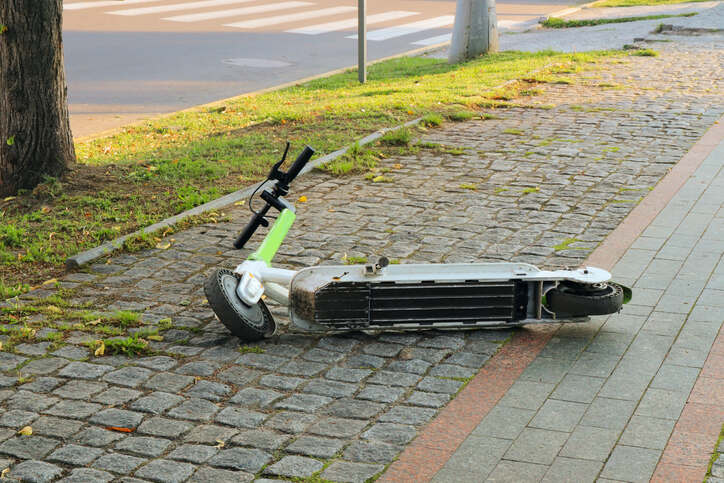
Denver Has More Than 5,000 Scooters on Its Streets. Not All of Them Belong There.
Love them or hate them, electric scooters are a fixture of life in Denver. Bird and Lime scooters populate sidewalks from Capitol Hill to RiNo, LoDo to the Platte River Trail. In 2024, nearly 5.8 million e-scooter trips were taken in Denver alone. That works out to roughly 15,000 rides every single day.
The city has promoted scooters as a way to reduce car trips and give people a last-mile option to connect with public transit. And for plenty of riders, they do exactly that. But there’s an honest flip side to this story, and Denver’s own data tells it plainly: 2025 was the deadliest year for e-scooter crashes the city has ever recorded.
Eight people died on scooters last year, more than in the previous six years combined. Denver Health reported nearly 2,000 scooter-related emergency room visits in 2024. Between 2019 and 2024, area emergency departments treated more than 4,400 scooter-related injuries, and head injuries accounted for 58% of them.
Scott O’Sullivan has been representing injured Coloradans for 25 years, and he’s watched scooters go from a novelty to a daily presence on Denver’s streets. In his view, the city has moved faster to promote these vehicles than to create meaningful accountability when they cause harm.
If you’ve been hurt, you need someone who understands both the legal landscape and the practical reality of how these cases get resolved in Colorado.
What the Law Actually Says About E-Scooters in Denver
The legal framework around electric scooters in Colorado is a patchwork, and that complexity matters when an accident happens.
At the state level, Colorado law classifies most shared rental scooters as low-power scooters. To qualify, the scooter must be electrically powered at no more than 4,476 watts, or run on an internal combustion engine with a cylinder capacity under 50cc.
Scooters meeting this definition do not require registration or insurance. Riders do not need a driver’s license to operate one. Adults are not legally required to wear a helmet, though anyone under 18 must wear one.
In terms of where scooters can be ridden, Colorado law is clear: low-power scooters are not permitted on sidewalks, interstates, or limited-access roads. They are allowed in bike lanes and on roadways, and riders must follow all standard traffic laws.
Denver has its own additional rules. Riding a scooter on a sidewalk is prohibited in Denver except when parking the scooter. Scooters are banned entirely from the 16th Street Mall. For years, parking was essentially unregulated, which is why you’d find scooters blocking curb cuts, tipped over on sidewalks, and abandoned in the middle of pedestrian paths.
That is now changing. In May 2025, Denver City Council unanimously passed new regulations requiring scooters to be fitted with sidewalk-detection technology and mandating designated parking zones in high-use areas including downtown and parts of Five Points.
The new rules take effect July 1, 2026. Councilmember Chris Hinds, the bill’s sponsor, put it plainly during the hearing: “This is a policy proposal to save lives. People are dying.”
Currently, Bird and Lime are the only two companies permitted to operate rental scooters in Denver under city contracts that run through mid-2026.
“The city has spent years promoting scooters as a transit solution while largely leaving riders and everyone else sharing the road to figure out the safety piece on their own. The rules are catching up, but slowly. In the meantime, people are getting hurt.” – Scott O’Sullivan, Founder, The O’Sullivan Law Firm
Why E-Scooter Accidents Are More Complicated Than They Look
If you’ve been hurt in a scooter crash, your first instinct might be to think it’s a straightforward matter. Someone was negligent, they have insurance, you file a claim. In reality, scooter accident cases involve a set of legal complexities that don’t exist in ordinary car accident cases, and several of them are designed to work against you.
The rental agreement you clicked through
When you unlock a Bird or Lime scooter through the app, you agree to a user agreement. Most people tap past it without a second thought. But buried in that agreement is an arbitration clause that requires disputes to be resolved through binding arbitration rather than in court.
This is not a neutral process. Binding arbitration consistently produces lower outcomes for injured people than court proceedings. An experienced attorney can evaluate whether the arbitration clause applies to your specific situation and whether any exceptions exist.
The company may not be liable for what their riders do to you
In November 2024, the Colorado Court of Appeals issued a significant ruling in a case called Harrington v. Neutron Holdings, holding that Lime could not be held liable simply because one of its users, believed to be intoxicated, rode a scooter into a pedestrian. The court found that e-scooter companies have no general duty to protect third parties from their users’ negligent actions.
One of the judges on the panel expressed discomfort with the result directly, asking aloud what recourse a pedestrian has when a scooter rider who was somewhere they shouldn’t have been zooms away after hitting them. The honest answer, under current Colorado law, is: not much, unless you can identify the specific rider and pursue them individually.
This doesn’t mean there is never a path to recovery against the company. There are narrower circumstances where liability can still attach, including cases involving defective equipment or potentially a rider the company should have known was dangerous.
But it does mean the legal landscape is harder than it should be, and it is exactly the kind of situation where having an attorney investigate thoroughly from the beginning makes a difference.
Scooter riders often don’t have insurance
Just as with e-bikes, scooters in Colorado do not require liability insurance. If an uninsured scooter rider caused your injuries, their personal assets and any applicable homeowner’s or renter’s policy may be the only source of recovery.
If a motor vehicle driver caused your crash, their auto liability coverage is the starting point, and your own underinsured motorist coverage becomes important if their limits are insufficient.
Poor road conditions can be a factor
Denver’s infrastructure doesn’t always accommodate the realities of scooter travel. Potholes, uneven pavement, poorly marked bike lanes, and abrupt curb transitions are all documented contributors to scooter crashes. When a road defect causes or contributes to an accident, a potential claim against the city or county may exist, but these claims come with strict notice requirements and short deadlines.
If road conditions played any role in your crash, this is something to raise with an attorney immediately.
What About Personal Scooters You/They Own?
Most of this page deals with rental scooters from Bird and Lime, because that’s what the majority of Denver scooter accidents involve. But personally owned electric scooters are increasingly common, and the legal picture around them is different in some important ways.
Standing electric scooters (capped at 20 mph)
Most of the personal scooters people buy for commuting or recreation, think of the popular Segway, Xiaomi, or similar brands, are classified by Colorado law the same as electric bicycles. If the scooter tops out at 20 mph under motor power, it does not require registration, insurance, or a driver’s license to operate. The rules about where you can ride are the same as for rental scooters: roads and bike lanes yes, sidewalks no (in Denver), interstates no.
This is where it gets important for injured people: because no insurance is required on these scooters, if someone riding a personal scooter causes your injuries, they may have no policy to pay a claim. Recovery depends on whether they carry homeowner’s or renter’s insurance, whether their policy covers scooter-related incidents (many don’t, or have exclusions), or whether you can pursue them personally.
If a car hit you while you were riding your own scooter, the driver’s auto liability policy and your own uninsured or underinsured motorist coverage become the primary avenues.
Sit-down moped-style scooters (low-power scooters)
A sit-down electric scooter with a motor up to 4,476 watts falls into a different legal category: the low-power scooter. These are treated more like vehicles under Colorado law. They must be registered with the Colorado DMV every three years, the owner must hold a valid driver’s license, and they are required to carry the same minimum liability insurance as a car, which is $25,000 per person and $50,000 per accident in bodily injury coverage.
If you are injured by someone riding an unregistered or uninsured moped-style scooter, that’s a violation of Colorado law on their part, and it affects how the case is pursued.
More powerful scooters
Any electric scooter exceeding 4,476 watts crosses into motorcycle territory under Colorado law. Operating one requires a motorcycle license and motorcycle insurance. If you’ve been hit by something that looked like a scooter but had the power of a motorcycle, its legal classification matters significantly for how liability and insurance are analyzed.
Why this matters if you’ve been hurt
The type of scooter involved in your accident, whether it was a rental, a personal standing scooter, or a moped-style machine, directly shapes where compensation might come from and how the case proceeds. We see cases where the at-fault rider had no insurance at all and cases where multiple policies may apply. The first step is always a thorough investigation of what was actually involved and what coverage exists.
If you were riding your own personal scooter and were hurt by someone else’s negligence, the same rights apply to you as to any other injury victim. The absence of required insurance on your end doesn’t diminish your claim against the person or entity that caused your injuries.
Who Gets Hurt, and How
Scooter crashes tend to cluster in predictable patterns. Research by the University of Colorado School of Medicine at the Anschutz Campus, based on Denver Health data, found that the most severe injuries occur at night and on weekends, and that alcohol is frequently a factor.
The most common age group involved in serious e-scooter injuries is adults between 25 and 37. Head injuries are the most frequently reported category, accounting for more than half of all scooter-related emergency room visits in Denver area hospitals.
This doesn’t mean only reckless riders get hurt. Plenty of people following every rule get hit by cars, clip a pothole, or are taken out by a scooter rider who wasn’t paying attention. But the data does tell us something useful: scooters are most dangerous in conditions where judgment and visibility are already compromised, and where the road surface is unreliable.
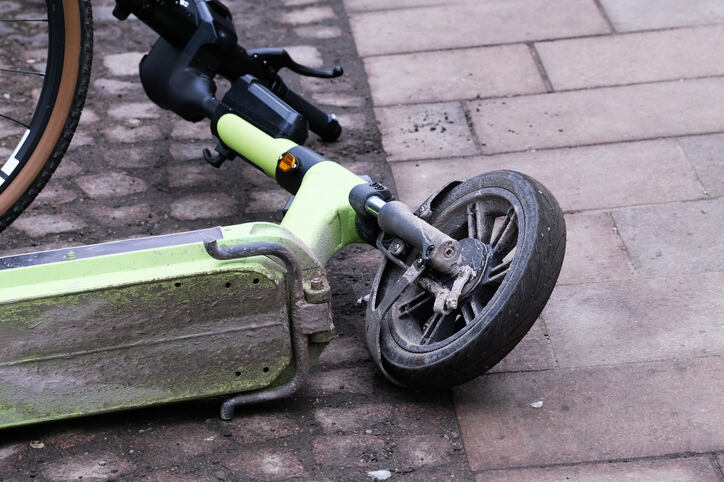
Common injuries we see in scooter accident cases:
- Head and brain injuries
Head injuries are by far the most common serious consequence of scooter crashes. Traumatic brain injuries, concussions, and facial fractures all appear regularly in Denver e-scooter injury data. Because adults are not legally required to wear a helmet, many riders who crash have no head protection at all. - Fractures
Wrist and arm fractures are extremely common, a result of the natural instinct to catch yourself in a fall. Hip, collarbone, leg, and ankle fractures also appear frequently, particularly in crashes involving motor vehicles or hard pavement contact at speed. - Spinal injuries
Even at 15 mph, a scooter crash can produce enough force to cause disc injuries, nerve damage, and in serious cases, lasting spinal cord injury. - Road rash and soft tissue injuries
Scooter riders have no protective gear between them and the pavement. Severe abrasions and ligament or tendon damage can require extensive treatment and produce long-term limitations. - Injuries to pedestrians and bystanders
Not everyone hurt in a scooter incident was riding one. Pedestrians struck by scooters, people who trip over abandoned scooters on sidewalks, and cyclists sideswiped by riders who weren’t where they were supposed to be are all part of the picture we see. If you were hurt by a scooter and you weren’t the rider, you still have rights.
What You May Be Owed
Insurance companies and scooter companies both move quickly after an accident to limit their exposure. We move just as quickly to make sure your losses are fully documented before anyone starts talking settlement.
- Medical expenses
Emergency care, hospitalization, surgery, imaging, physical therapy, and any future treatment needs directly tied to your injuries. - Lost wages and earning capacity
Time away from work during recovery, and when injuries are lasting, compensation for reduced ability to earn going forward. - Pain and suffering
Colorado law allows recovery for the physical pain and emotional toll of a serious injury. These non-economic damages are real and they matter, and we fight for them as hard as we fight for anything else. - Property damage
Personal property damaged in the crash, including your own scooter if you were riding one. - Wrongful death
When a scooter crash takes a life, we represent the family with the same commitment we bring to every case. See the recent legislative changes in Colorado concerning wrongful death.
What to Do If You’ve Been Hurt
- Get medical help immediately, even if you feel okay
Concussions, internal injuries, and soft tissue damage routinely don’t announce themselves right away. Get evaluated before you decide you’re fine. Your health comes first, and a medical record from the day of the accident is one of the most important pieces of documentation in any personal injury case. - Call the police
Request a police report. Under Colorado law, law enforcement is required to complete a report for any injury incident involving a scooter on the state’s roadways, even without a motor vehicle involved. Get the report number before you leave. - Document the scene
Photograph the scooter, its position, the road surface, any damage, and any visible injuries. Get the contact information of anyone who witnessed what happened. If you were riding a rental scooter, note the scooter’s ID number from the app or the vehicle itself before the company retrieves it. - Don’t give a recorded statement to any insurance company
Insurers will contact you quickly. They are not trying to help you. Decline to give any recorded statement until you have spoken with an attorney. - Watch the clock
The general statute of limitations for personal injury claims in Colorado is three years from the date of the accident. If a government entity may be responsible, such as the city for a road defect, you may have as little as 180 days to file a formal notice of claim. Don’t assume you have time to sort it out later. - Understand your rental agreement
If you were riding a rental scooter, or if the person who hurt you was, the terms of that agreement become relevant immediately. The arbitration clause, the waiver of liability, and how the company’s insurance interacts with your claim all need to be reviewed by someone who knows what to look for. Do not accept a company’s initial position on coverage without getting independent legal advice. - Talk to an attorney before you accept anything
Early settlement offers from insurance companies are made before the full extent of your injuries is known. Once you sign a release, you cannot go back for more, even if your condition worsens. There is no cost to a consultation with us, and understanding your options before you act can make an enormous difference in your outcome.
Why It Matters That an Attorney Handles Your Case Directly
There’s a gap between what scooter accident victims expect the legal process to look like and what it actually is. The rental company has legal teams and arbitration clauses. The insurance company has adjusters whose job is to settle fast and low. And Colorado’s courts, as the 2024 Lime ruling demonstrated, have not yet imposed the kind of accountability on scooter companies that most people would assume exists.
That doesn’t mean there’s nothing to recover. It means you need someone who understands where the leverage actually is.
Scott O’Sullivan spent years as an insurance defense attorney before spending the last 25 years representing injured people. He knows how the other side thinks, what they look for, and where they’ll try to take advantage of someone who doesn’t have experienced help. Our firm is small by design. When you hire us, an attorney works your case from the first call to the final resolution. You are not handed off to a paralegal or a case manager.
“I became a lawyer to help others, and it remains my calling. In fighting for victims’ rights, we side with the underdogs, the people who were injured through someone else’s negligence, and we fight for what’s truly fair.” – Scott O’Sullivan
- 25+ years representing injured Coloradans in Denver and throughout the state
- 99% success rate across 2,000+ resolved cases since 2008
- Rated 4.9 out of 5 stars on Google
- No fee of any kind unless we win your case
Common Questions About E-Scooter Accident Claims in Denver
Can I sue Bird or Lime if their scooter or one of their riders injured me?
It depends on the circumstances. In 2024, the Colorado Court of Appeals ruled that scooter companies cannot be held liable simply for making scooters available to users who go on to injure others. However, liability may still attach in certain situations, including defective equipment, negligent maintenance, or potentially where the company had reason to know a rider posed a danger.
If a rider caused your injuries, pursuing them individually, and tracing any applicable insurance coverage, is often the more viable path. We investigate every available avenue before drawing conclusions.
The rental agreement said I waived my right to sue. Does that mean I have no options?
Not necessarily. User agreements that require arbitration and waive certain claims can be challenged, and their scope is not unlimited. These agreements deserve careful review by an attorney before you accept that they foreclose your options entirely.
What if I was walking or cycling and a scooter hit me?
Your rights as a pedestrian or cyclist injured by a scooter rider are essentially the same as in any personal injury case. You can pursue the individual rider and, depending on the circumstances, potentially other parties. The fact that you weren’t riding the scooter does not complicate your claim. If anything, it simplifies it.
What if I fell because of a pothole or road defect while riding a scooter?
If a road defect caused or contributed to your crash, a claim against the city or county responsible for maintaining that roadway may be possible. These claims come with strict procedural requirements and short deadlines, sometimes as few as 180 days to file a notice. If road conditions were a factor, contact us as soon as possible.
Does it matter that I wasn’t wearing a helmet?
Colorado does not require adults to wear helmets on scooters. Not wearing one may be raised by the other party as a factor in the accident, potentially affecting your comparative fault calculation, but it does not bar you from recovering compensation.
Under Colorado’s comparative negligence system, you can still recover damages as long as you are found to be less than 50% responsible. We work to ensure fault is assessed fairly and that you’re not assigned blame that isn’t yours.
What if the scooter rider fled the scene?
This is a real problem in scooter accident cases and one of the reasons the Colorado Court of Appeals judge expressed frustration with the current state of the law.
If you were hit by a rider who left, your own uninsured motorist coverage may apply if you have it and were in or on a vehicle at the time. We’ll look at every available avenue and be straight with you about what the options are.
Scooter accident cases move fast, and so do the companies involved. Evidence disappears. Arbitration clauses get invoked. Early settlement offers arrive before you know the full extent of your injuries. The best time to call is now.
Call or text (303) 388-5304 to speak with a lawyer. Advice is always free.
If we can take your case, you’ll pay nothing until we win.
The information on this page is for general informational purposes and does not constitute legal advice. Contact our office to discuss the specific facts of your case.
