victims for over 25 years.
Colorado Traffic Deaths Rose in 2025
Colorado saw a hard turn in the wrong direction in 2025.
After two straight years of declining fatalities, preliminary statewide data shows 701 people were killed on Colorado roadways in 2025, up from 689 in 2024. That increase may look small on paper, but it matters because it suggests risky driving behaviors are creeping back, especially when it comes to impaired driving and the safety of people outside a vehicle.
From The O’Sullivan Law Firm’s perspective, these numbers are not abstract. Their team works with crash victims every day, and they see what a “statistic” really looks like in real life: emergency rooms, surgeries, missed work, long rehab, and families trying to make sense of something that should have been preventable.
The story of 2025: progress, then a late year surge
One of the most important takeaways from CDOT’s release is that 2025 was on track to improve, until the end of the year.
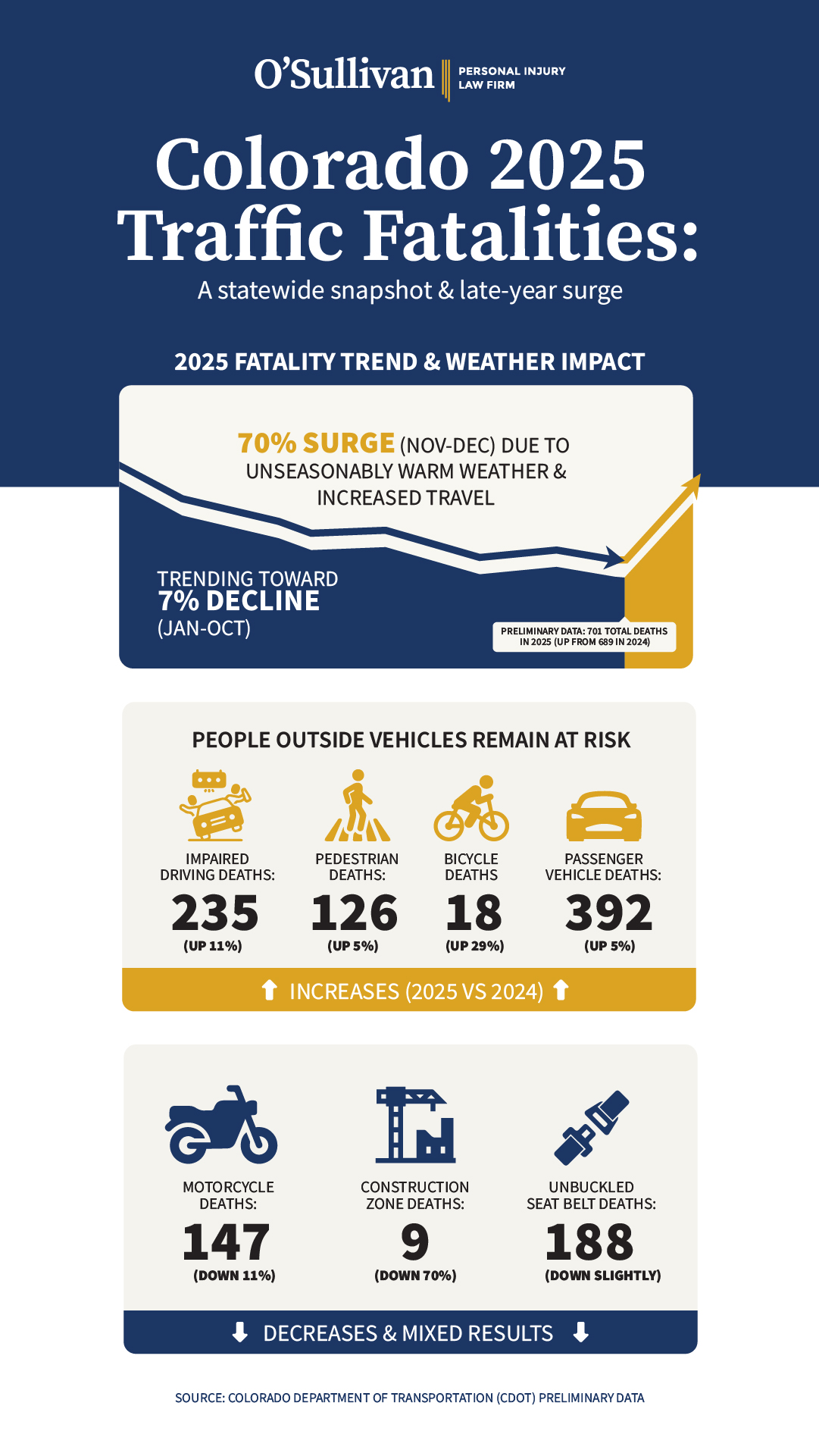
CDOT reports that traffic deaths were trending toward a 7% decline in 2025 until unseasonably warm November and December coincided with more people on the roads. During those final two months, fatalities jumped 70% compared to the same period in 2024, with the surge most visible along the Front Range.
This matters for Colorado because our driving environment changes with the seasons. When weather stays mild, more motorcycles, cyclists, and pedestrians stay active later into the year, and overall road exposure rises. If driver behavior does not improve at the same time, the result is exactly what we saw: a spike.
The saddest numbers are the ones that keep showing up: impairment and vulnerable road users
CDOT’s preliminary breakdown points to two areas that demand attention.
Impaired driving increased
In 2025, impaired driving deaths rose to 235, an 11% increase from 2024. Colorado State Patrol highlighted this as a “sobering reminder” and emphasized personal responsibility, including not driving after consuming alcohol or cannabis, following speed limits, and putting the phone down.
From a personal injury standpoint, impaired driving crashes are often among the most devastating because they tend to involve higher speeds, delayed reaction times, and violent impacts. They also raise serious legal issues, including the potential for punitive damages in some cases.
People outside vehicles remain at risk
CDOT’s data shows continued danger for pedestrians and cyclists:
- Pedestrian deaths: 126, up 5%
- Bicycle deaths: 18, up 29%
That is the direction Colorado cannot accept. When a person walking or biking is struck, the human body absorbs forces it was never meant to handle. Even “low speed” impacts can change a life permanently.
The full picture: what went up, what improved
Here is the statewide snapshot CDOT shared for 2025 (preliminary).
Increases
- All traffic deaths: 701 (up 2%)
- Passenger vehicle deaths: 392 (up 5%)
- Impaired driving deaths: 235 (up 11%)
- Pedestrian deaths: 126 (up 5%)
- Bicycle deaths: 18 (up 29%)
Improvements or mixed results
- Motorcycle deaths: 147 (down 11%)
- CDOT also noted a late year increase in motorcyclist fatalities tied to warmer weather, which is a reminder that riders remain vulnerable when the season stretches longer than usual.
- Construction zone deaths: 9 (down 70%)
- Unbuckled seat belt deaths: 188 (down slightly)
Even where the numbers improve, the goal is not “better than last year.” The goal is fewer families getting the worst phone call of their lives.
Where the losses are concentrated: Denver and the Front Range
CDOT also identified where fatalities were highest.
Cities with the highest fatalities (2025)
- Denver: 76 (up 21%)
- Aurora: 55 (up 22%)
- Colorado Springs: 49 (up 4%)
- Pueblo: 21 (same as 2024)
- Lakewood: 16 (down 24%)
Counties with the highest fatalities (2025)
CDOT lists Denver and Weld at 76, El Paso at 75, then Adams and Arapahoe at 59, among others.
This clustering matters because it helps focus solutions. Different regions have different crash patterns: urban pedestrian exposure, suburban speed corridors, construction zones, rural two lane highways, and weekend recreation traffic.
What Colorado is doing about it in 2026
CDOT, Colorado State Patrol, and the DMV outlined several strategies aimed at reversing the trend.
CDOT’s Strategic Transportation Safety Plan sets a goal of reducing fatalities and serious injuries by 5% per year, or 22.6% by 2030, using a Safe System approach across areas like safe roads, safe people, safe driving, safety culture, and post crash care.
Specific actions highlighted include expanding speed enforcement in construction zones, continuing bicycle and pedestrian infrastructure improvements, running impairment enforcement campaigns and seat belt enforcement, and promoting safety initiatives statewide.
CDOT also pointed to the importance of Senate Bill 25-030, which focuses on identifying and closing infrastructure gaps for people walking, rolling, and biking by July 2026, including better connected bike lanes, improved crosswalk visibility, and pedestrian focused signal timing.
Meanwhile, Colorado’s Hands-Free Law is now fully implemented, and updated child restraint laws are in effect, including booster seat and rear facing requirements at older ages than many families expect. The DMV also referenced upcoming changes like more rigorous minor driver education rules beginning in 2027.
These are meaningful steps. Enforcement, education, and roadway design can absolutely reduce deaths, but only if drivers meet the moment with better decisions.
“Crash, not accident”: why language matters
CDOT included a note to media that is worth repeating: crashes are preventable, and the word “accident” can blur accountability.
At The O’Sullivan Law Firm, that framing aligns with what they see in case after case. Many collisions are not random. They are linked to choices: impairment, distraction, speeding, ignoring right of way, unsafe turns, and failing to look for riders, cyclists, and pedestrians.
Accountability matters not only for justice, but for prevention. When we treat preventable harm as unavoidable, we lower the standard for everyone.
How The O’Sullivan Law Firm is trying to help Colorado families
The O’Sullivan Law Firm is not a call center and not a volume practice. They take cases personally because that is the only way to do this work well.
Here is what “help” looks like in practice.
Helping injured people rebuild their lives
After a serious crash, victims face a confusing mix of medical bills, time off work, insurance pressure, and paperwork that feels designed to wear you down. The firm’s job is to step in, protect the client, and fight for full compensation, not a quick settlement that looks good on an insurance spreadsheet.
That includes investigating fault, preserving evidence, working with medical providers, documenting long term consequences, and, when needed, pushing a case toward trial.
Supporting safer roads through education and advocacy
When CDOT points to impairment and vulnerable road user deaths, that is not just policy talk. Those trends show up in the firm’s work, especially with pedestrians, cyclists, and motorcyclists.
Through consistent public education, local community involvement, and straight talk about what causes crashes, the firm aims to reduce the human cost. They want better driving culture and better infrastructure, because prevention is the best outcome.
Making sure people know what to do immediately after a crash
If you or someone you love is involved in a crash, the first steps matter:
- Call 911 and get medical care right away, even if symptoms feel minor.
- If you can, document the scene, vehicles, road conditions, and injuries.
- Get witness contact information.
- Don’t provide recorded statements to insurance companies, including your own, before you understand the full picture of injuries and coverage.
- Talk to a lawyer early if there is an injury, a pedestrian or bicycle strike, a motorcycle crash, a suspected impaired driver, or a dispute about fault, including due to a third party (e.g. Uber).
Colorado can do better, and 2025 proved we cannot get complacent
The most frustrating part of this data is that Colorado was moving in the right direction. Two years of declining fatalities showed that improvement is possible. The late year surge is a warning that progress can disappear fast when road exposure rises and risky behavior keeps showing up, especially impairment and failures to protect people walking and biking.
If you have questions after a crash, or you are dealing with an injury that should never have happened, call or text The O’Sullivan Law Firm at (303) 388-5304 for free advice.
Colorado 2025 Traffic Fatalities Infographic