- Home
- About
- Practice Areas
- Personal Injury Overview
- Car Accidents
- Bicycle Accidents
- Burn Injury
- Brain Injury
- Dog Bite
- Vibrio Vulnificus
- Infection from Saline Solution
- Motorcycle Accidents
- Pedestrian Accident
- Product Liability
- Scooter Accident
- Slip and Fall Accidents
- Spinal Cord Injury
- Underinsured Driver Accident
- Rideshare Accident
- Truck Accident
- Wrongful Death
- View All +
- Testimonials
- Resources
- Cities
- Español
- Contact

Helping Colorado’s accident
victims for over 25 years.
victims for over 25 years.
How to Protect Yourself on an E-Bike in Colorado
POSTED BY
April 16, 2026
Bicycle
Bicycle/Motorcycle Accidents
We spend a lot of time at this firm dealing with the aftermath of accidents: the injuries, the medical bills, the insurance disputes, the long road back. If we can help someone avoid that experience in the first place, that’s worth something. So this week, a practical look at how to ride an e-bike in Colorado more safely.
None of what follows is meant to be legal advice or a complete safety manual. It’s the kind of thing Scott would tell a friend before they headed out on a new e-bike for the first time.
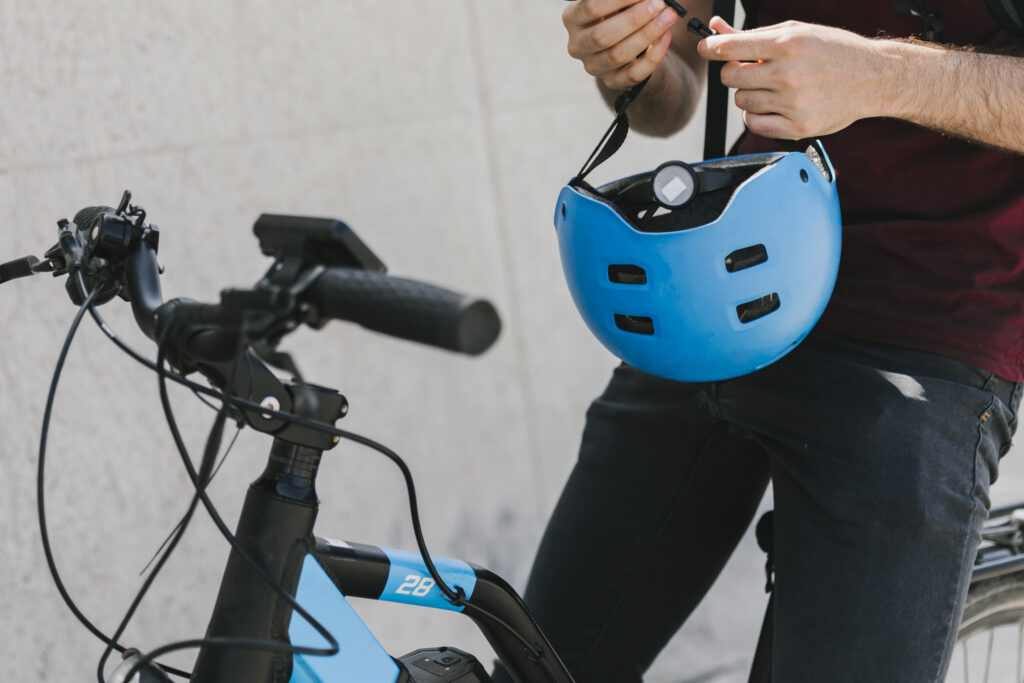
Get the Right Helmet, and Actually Wear It
Colorado does not legally require adults to wear a helmet on a Class 1 or Class 2 e-bike. It does require riders under 18 to wear a helmet on a Class 3 bike. But the law sets a floor, not a ceiling.
E-bikes travel significantly faster than traditional bicycles, and in a crash, a standard bicycle helmet may not provide the same level of protection it would at lower speeds. The Colorado Department of Transportation specifically recommends helmets designed for e-bike riders. If you ride a Class 3 bike or frequently ride in traffic, look for a helmet certified to the NTA-8776 standard, which was developed specifically for higher-speed cycling. For more casual Class 1 or Class 2 riding, a quality CPSC-certified helmet with MIPS technology is a solid choice.
Wear it every ride. This is not a suggestion that varies based on how far you’re going or how good the weather is.
Understand How Your Specific Bike Handles
This sounds obvious, but it’s genuinely important. E-bikes handle differently from traditional bicycles in ways that catch new riders off guard. The weight is distributed differently. The motor engagement, especially on throttle-equipped Class 2 bikes, can produce acceleration that feels abrupt if you’re not used to it. Braking distances are longer.
Before riding in traffic or on a shared trail, spend time getting comfortable with your bike in a low-stakes environment: an empty parking lot, a quiet neighborhood street. Practice braking at different speeds. Get a feel for how the bike responds at 20 mph compared to 10 mph. Know what happens when the motor kicks in on a hill. That familiarity could be the difference between recovering from an unexpected situation and going down.
Know Where Your Class of Bike Is Allowed
This is particularly relevant for Class 3 riders. In Colorado, Class 3 e-bikes are restricted from most shared bike and pedestrian paths. Riding your Class 3 bike on a multi-use trail isn’t just a potential ticket. It puts faster, heavier equipment into a space shared with pedestrians, families with young children, dogs on leashes, and traditional cyclists moving at much lower speeds. Those encounters don’t always end well.
Denver has additional local rules about sidewalk riding. Multi-use trail rules vary by specific trail and by the managing entity. Before you ride somewhere new, take five minutes to check the rules for that specific location. CDOT’s e-bike safety resources and Bicycle Colorado’s rules of the road page are both useful starting points.
Be Visible, and Assume You Are Not
Lights are legally required when riding at dawn, dusk, or after dark: a white front light visible from at least 500 feet, and a red rear reflector. But riders who limit their lights to those conditions are missing the point of being visible.
Denver’s crash data shows that most bicycle and e-bike accidents happen in clear daytime conditions, not in the rain or dark. Visibility is about being seen by drivers who aren’t looking for you, not just about navigating low-light conditions. Front and rear lights used even in daylight, bright or reflective clothing, and positioning yourself to be visible rather than convenient will all reduce your risk.
Never assume a driver has seen you. Make eye contact at intersections when you can. Ride predictably and hold your line. Signal your turns. Announce yourself to pedestrians and other cyclists on shared paths.
Watch Your Speed Relative to Your Surroundings
Class 3 e-bikes can assist up to 28 mph. Class 1 and Class 2 bikes can assist up to 20 mph. Just because a bike can go that fast doesn’t mean it always should.
On a crowded trail, 20 mph is dangerous. In a bike lane alongside stopped traffic where car doors might open, 25 mph is dangerous. On a downhill approach to an intersection, even 15 mph might be too fast if you can’t see what’s coming. Speed is one of the primary factors in both accident occurrence and injury severity. The right speed is the one that gives you enough reaction time for whatever is in front of you.
The Colorado Springs guidance on this is worth repeating: just because you can doesn’t mean you should.
Take the Battery and Equipment Seriously
Lithium-ion battery fires have caused extreme injuries and property damage, including in Colorado. This is part of why the 2025 state legislation required battery certification standards. When you buy an e-bike, buy from a reputable dealer and look for batteries certified to UL 2849 or EN 15194 standards. Avoid charging overnight unattended, especially with budget bikes from unknown manufacturers.
Beyond the battery: check your brakes, tires, and lights before each ride. An e-bike with worn brake pads has significantly less stopping power than one that’s properly maintained, and stopping power matters more on a heavier, faster vehicle. Keep the bike in good working order.
Ride Sober
This may seem unnecessary to state, but Colorado law applies DUI rules to e-bike riders. A blood alcohol concentration of 0.08% or higher can result in a DUI charge on an e-bike, not just in a car. Beyond the legal exposure, impairment reduces reaction time and judgment in exactly the situations where e-bike riders need them most.
“People are sometimes surprised to learn this, but if you’re impaired on a bike or e-bike in Colorado, you can be charged with a DUI. The law doesn’t distinguish. And frankly, neither does the physics.” – Scott O’Sullivan
A Note on What Safety Doesn’t Guarantee
Riding carefully and following all of these guidelines will meaningfully reduce your risk. It will not eliminate it. Denver’s roads are busy. Drivers are distracted. Road surfaces in some parts of the city are poorly maintained. Other cyclists and pedestrians behave unpredictably.
If you do everything right and still end up hurt because someone else was negligent, the fault is not yours. But riding carefully also helps in another way: it helps establish, if your case ever ends up in dispute, that you were doing what a responsible rider was supposed to do.
Scott O’Sullivan has been representing injured Coloradans from his Denver office for over 25 years. If you have questions about an e-bike accident, call or text The O’Sullivan Law Firm at (303) 388-5304 for a free consultation. There’s no obligation, and you’ll speak directly with an attorney.
